Dash cams

Dashcam installation in Calgary

A dash cam is only as good as the way it is fitted. We hardwire cameras at our northeast Calgary shop so the cabling sits behind the trim, the camera runs off the vehicle instead of tying up a 12-volt socket, and everything is tested with you before you drive away.

  • Hidden wiring

    Cables run behind the headliner, A-pillar and trim panels rather than across the glass.

  • Parking-mode hardwiring

    Wired to the fuse panel using the hardwire kit your camera supports.

  • Front, rear and in-cabin

    One, two or three channels, chosen around how you actually use the vehicle.

  • Fitted and tested here

    Installed in our northeast Calgary bay, then set up and checked with you.

What this is

Buying the camera is the easy part

Most dash cams arrive with a suction mount and a long cable meant for the cigarette lighter. That will record. It also leaves a wire hanging down the windscreen, occupies your 12-volt socket, and stops recording the moment you switch the car off.

The install is the part that turns a camera into something you forget is there. Power is taken from the fuse panel so the camera comes on and off with the vehicle, the cable is routed inside the trim, the camera sits where it sees the road without blocking your view, and any rear or in-cabin channel is run through the vehicle properly.

We quote per vehicle rather than from a fixed price list, because routing a cable through a hatchback and routing one through a three-row SUV are not the same job. Tell us the year, make and model and what you want it to cover, and we will confirm the price before we start.

Configurations

Front, front and rear, or three channels

Dash cams are sold by channel count. The right one depends on what you want a record of, not on which box costs the most.

Front only

A single camera behind the mirror recording the road ahead. The simplest fit and the least cabling. If what you want is a record of what happened in front of you, this covers it, and it is the quickest install of the three.

Front + rear

Adds a second camera at the back so you have both directions. This is the configuration most drivers ask us for. It is also the one that adds rear cable routing to the job, which is where most of the extra labour sits.

Front + rear + in-cabin

Adds a third camera for in-cabin recording, facing the interior. The usual choice for rideshare and delivery drivers, or anyone who wants a record of what happens inside the vehicle. Most private drivers do not need it.

More channels is not automatically better. Tell us how you use the vehicle and where it is parked, and we will tell you what is actually worth fitting.

Hardwiring

Wired into the vehicle, not draped across it

Hardwiring is the difference between a camera that looks like it came with the car and one that looks like an accessory. It is the part of this job we spend the most time on.

What the install covers

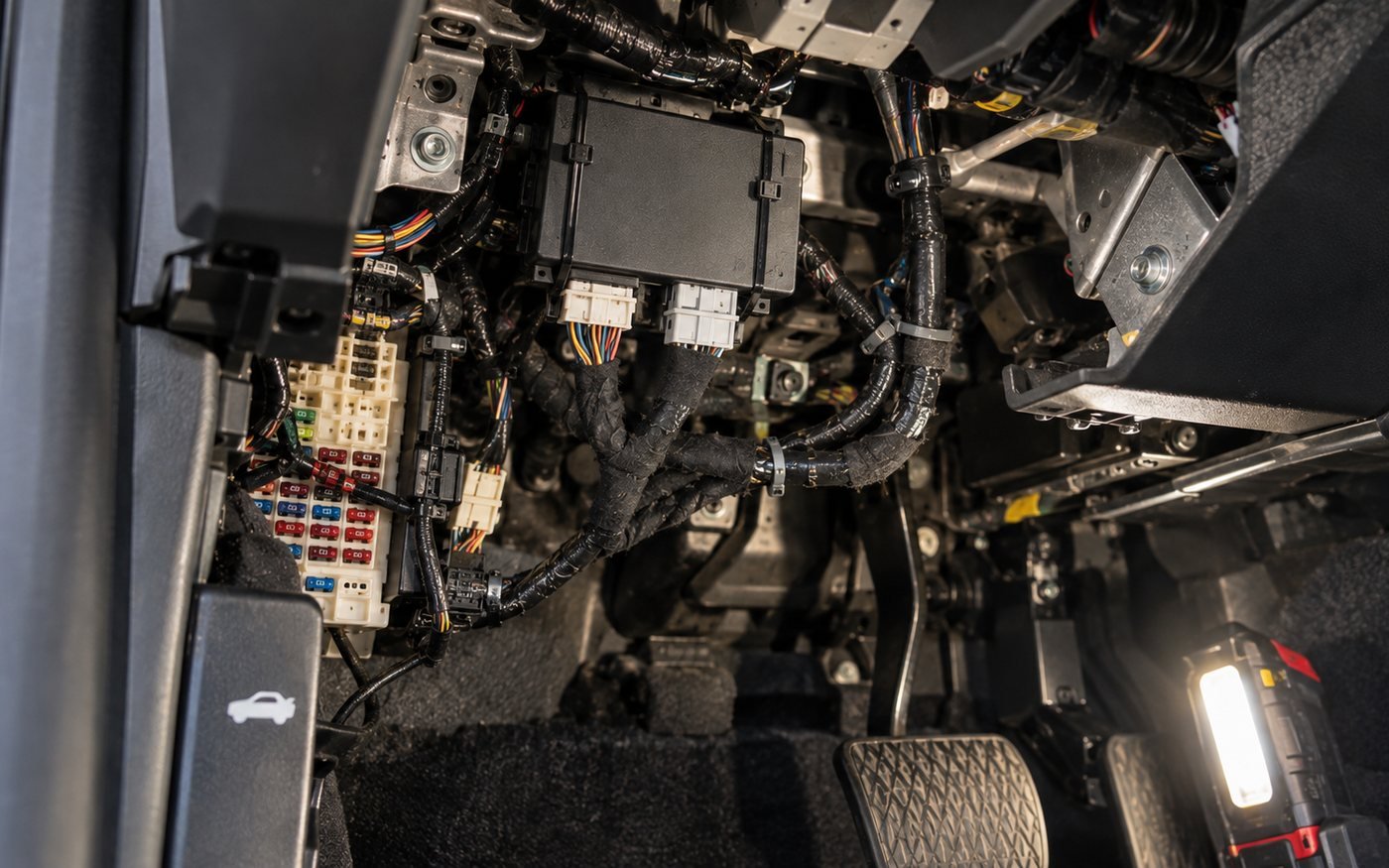
  • Cable routed behind the headliner, A-pillar and trim, out of sight from the driver’s seat
  • A suitable circuit chosen at the fuse panel for the camera’s draw
  • Constant power where the camera needs to run with the ignition off
  • An ignition or accessory feed where the camera should follow the key
  • A proper ground, made to a point intended to carry it
  • The manufacturer’s hardwire kit fitted where parking mode is wanted
  • Low-voltage protection configured where the kit and camera support it
  • Rear-camera cable run through the vehicle rather than taped along the roofline
  • Camera positioned for a clear view without obstructing yours
  • Recording, loop, event capture and the phone app checked before you leave

Which of those apply depends on the camera and the vehicle. A single-channel camera that only needs to run while you drive is a much shorter job than a three-channel setup with parking mode on a vehicle with a powered tailgate.

Fuse-panel work is the part that most often goes wrong when a camera is fitted in a hurry: the wrong circuit, a tap that works loose, or a ground made to a painted panel. We would rather take the time on that than have you back with an intermittent fault.

We are describing the service here rather than writing a wiring guide. If you want to know exactly what we would do to your vehicle, ask us and we will talk it through before you book.

Want a camera fitted properly?

Parking mode

What parking mode actually does

Parking mode is the feature most people are really after: the camera keeps an eye on the vehicle after you have walked away from it. It is also the feature that most depends on the hardware you have bought.

To record with the ignition off, a camera needs power with the ignition off. That is why parking mode generally means a hardwire kit rather than the 12-volt socket, which on most vehicles cuts out with the key.

What the camera then does while parked varies by model. Depending on the camera and kit, that may include some of the following — not every camera supports all of them, and some support none:

  • Motion detection. The camera starts recording when it sees movement near the vehicle.
  • Impact or event recording. A knock or jolt triggers a saved clip.
  • Time-lapse. A continuous low-frame-rate record of the whole time you were parked.
  • Low-power parking recording. A reduced-draw mode offered on some models.

Before you buy, it is worth checking that the camera you are looking at supports the parking behaviour you want, and that a hardwire kit is available for it. If you tell us the model, we will check that with you.

Parking mode draws power from the vehicle while it is parked. How much, and for how long, depends on the camera, the mode and the kit. We set it up to the protection your hardware supports and explain what to expect on your vehicle.

Power management

Battery and low-voltage protection

Anything that runs while the engine is off is drawing on the battery. That is true of a dash cam in parking mode as much as anything else, and it is why the power side of the install matters.

How protection works

Most parking-mode hardwire kits include low-voltage protection. The kit monitors system voltage and cuts power to the camera when voltage falls to its configured threshold, so the camera stops drawing before the battery is pulled down further. Some kits also have a timer that ends parking recording after a set number of hours.

The thresholds available, and whether they can be adjusted, depend on the kit. We set them to sensible values for your vehicle and tell you what they are.

What we will not tell you is that parking mode can never affect your battery. A protection cut-off is a safeguard, not a guarantee, and it cannot compensate for a battery that is already weak or a vehicle that is only driven short distances. If your battery is near the end of its life, parking mode will find that out for you.

If you park for long stretches — at an airport, or over a winter week away — tell us, because that changes what we would recommend and how we would configure it.

On the day

How the install goes

Camera and vehicle check

We confirm the camera, the hardwire kit and how you want it to behave, look at the vehicle, and confirm the price before anything is opened up.

Positioning

We place the camera where it has a clear view of the road and does not sit in yours, and agree the position with you before it is mounted.

Routing and hardwiring

Cable goes behind the headliner and trim, power is taken at the fuse panel, the ground is made properly, and any rear or in-cabin channel is run through the vehicle.

Setup and testing

We set the date, time and recording options, check the app connection, confirm parking mode behaves as expected, and show you how to pull footage off it.

Open Monday to Saturday, 10:30 a.m. to 6:30 p.m. Closed Sundays. Most single-camera installs are same-day; multi-channel and parking-mode jobs take longer, and we will tell you which yours is when we quote it.

Rear cameras

Getting the rear cable through the vehicle

Adding a rear camera is where a dash cam install stops being quick. The camera itself takes minutes. Getting its cable from the back of the vehicle to the front, invisibly, is the work.

Sedans

The cable runs along the headliner and down a pillar, with the camera usually on the rear glass. Generally the most straightforward of the body styles, because nothing the cable crosses moves.

SUVs and hatchbacks

The tailgate opens, so the cable has to cross from body to hatch. That crossing is done through the factory rubber boot with the existing looms, which is slower but keeps the cable protected and hidden.

Trucks and vans

Depends heavily on where you want the camera — rear glass, cab, or the back of the box. We will look at the vehicle and tell you what is realistic before you commit to it.

What we will not do is tape the cable along the roofline or run it around the door seals on the outside. It looks temporary, it catches, and it fails in a Calgary winter. If a clean route is not possible on a particular vehicle, we will tell you that before we start rather than improvise.

Your own camera

Bring a camera you already own

Yes — we fit customer-supplied cameras regularly, and we have no problem with a camera you bought online. A camera bought anywhere is only as good as the install.

What the job involves, and what it costs, depends on a few things we need to know before you book:

  • The model. Tell us exactly what you have, so we can check how it is powered and mounted.
  • The hardwire kit. Parking mode generally needs the kit made for that camera. If you do not have one, tell us and we will check whether it is available.
  • Channel count. One, two or three cameras changes the routing work substantially.
  • The vehicle. Year, make and model, because routing differs so much between body styles.
  • Whether you want parking mode. This is the single biggest factor in how the camera gets wired.

We cannot promise in advance that every camera will do everything you want it to — some models simply do not support parking mode, and some have no hardwire kit available. Send us the model before you book and we will tell you honestly what it can and cannot do.

Equipment

Cameras we keep, and cameras we fit

We keep FineVu cameras at the shop, and we will fit a camera from any brand you bring us.

We are not going to reproduce a catalogue here. If you are buying rather than bringing your own, the useful conversation is a short one: tell us your budget, how you use the vehicle and where it is parked overnight, and we will point you at something appropriate rather than at the most expensive thing on the shelf.

If you would rather read first, we wrote a comparison of what actually matters in a Calgary winter: the best dash cam for a Calgary winter.

Why it matters who fits it

Where a dash cam install goes wrong

None of this is exotic. It is simply the difference between a job done at a bench and a job done in a hurry.

A-pillars and curtain airbags

The A-pillar is a common cable route and, on most modern vehicles, also where a curtain airbag sits. Cable is routed so it stays clear of the airbag and its deployment path.

Fuse-panel work

The circuit chosen, how the connection is made and where the ground goes all decide whether the camera behaves in two years. This is the part worth doing slowly.

Trim and headliner

Panels come off with the right tools and go back without marks, rattles or gaps. Broken clips are cheap to avoid and irritating to live with.

Camera positioning

High and close to the mirror keeps the lens in the wiper sweep and out of your sightline. Badly placed cameras block your view or film the sky.

Questions

Dash cam questions we get asked

How much does dashcam installation cost in Calgary?

We quote per vehicle. Routing differs a lot between models, and a rear or in-cabin channel adds real work. Send us the year, make and model and what you want covered, or book a slot — either way we confirm the price before we start.

Will a dash cam drain my battery?

While you are driving, no — the camera runs off the vehicle. In parking mode it does draw power, because it has to. Hardwire kits with low-voltage protection cut the camera off at a set voltage to stop the draw before the battery falls further. That is a safeguard rather than a guarantee, and it cannot make up for a battery that is already weak.

Does it record while the car is parked?

If the camera supports parking mode and it is hardwired, yes. What it records — motion, impacts, time-lapse — depends on the model. A camera plugged into the 12-volt socket usually cannot do this at all, because that socket cuts out with the ignition on most vehicles.

Can you install a dash cam I bought myself?

Yes, we do that regularly. Tell us the model and whether you have the hardwire kit for it when you book, so we can check what it supports before you arrive.

Will the wiring be visible?

It should not be. Cable is routed behind the headliner, A-pillar and trim panels. From the driver’s seat you should see the camera and nothing else.

Do you install rear cameras too?

Yes. The cable is run through the vehicle rather than taped along the roofline, including across the tailgate on SUVs and hatchbacks, which is the slower but correct way to do it.

What is an in-cabin camera for?

It faces the interior and records inside the vehicle. Rideshare and delivery drivers are the usual customers for it. Most private drivers do not need one.

How long does it take?

A single front camera is usually a same-day job. Front and rear takes longer, and adding parking mode with a hardwire kit longer still. We will tell you which yours is when we quote it.

Will fitting a camera affect my airbags or factory trim?

It should not, and that is exactly why the routing matters. Cable is kept clear of the curtain airbag in the A-pillar, and trim is removed and refitted with the proper tools.

Can you fit a camera to a leased or company vehicle?

Usually, but check your lease or fleet policy on hardwired accessories first. If you would rather not have anything wired into the fuse panel, tell us and we will talk through what is possible.

Tell us about your vehicle

Send the details and we will come back with a price for your vehicle. No call centre, no generic quote.

Tell us what you drive and what you want it to see

Send us the year, make and model, the camera if you already have one, and whether you want it recording while parked. We will confirm the price before anything is opened up.

#129 10985 38 St NE, Calgary AB T3N 1Z2 · Monday to Saturday, 10:30 a.m.–6:30 p.m.